

Guide · Ponds
Floating fountain or aerator: which does your pond need?
Both move water and add oxygen. The right choice depends on whether the pond needs to look better, work better, or both.

Do I need a floating fountain or an aerator?
Choose a floating fountain when the pond needs to look good and some aeration is a bonus. Choose a dedicated aerator when water quality is the main problem: algae, odour, muck or mosquitoes. Many ponds use both. Pond depth, size, inflows and how the site is used decide which works best.
The difference is where the energy goes. A display fountain spends much of its effort throwing water into the air. An aerator spends it moving water through the pond.
How each one works.
A floating fountain sits on a float with a motor and pump below. It throws water into the air in a spray pattern, and the water picks up oxygen as it falls back.
A surface aerator, such as a Kasco surface aerator, also floats but keeps the spray low. More of its energy goes into moving a large volume of water near the surface.
A diffused aeration system uses a compressor on shore to push air through tubing to diffusers on the pond bottom. Rising bubbles lift bottom water to the surface and circulate the whole water column, which suits deeper ponds.

Signs a pond needs aeration first.
- Green water or surface algae mats in summer
- A rotten-egg or musty odour
- Muck building up on the bottom
- Mosquitoes breeding in still water
- Fish gasping at the surface on hot mornings
- Stormwater inflow carrying fertilizer and silt
A fountain helps with all of these. A pond showing several signs usually needs more circulation than a display alone can give.
What’s different about Ontario ponds?
Ontario ponds swing from ice cover to warm, still summer water. Late summer is when oxygen runs lowest and algae is at its worst, so that is when circulation matters most.
Municipal stormwater ponds also collect runoff from roads and lawns, which carries silt and nutrients. Those ponds usually need steady aeration more than a display.
Winter adds one more decision. Floating fountains come out in fall, while some aeration and de-icing equipment can keep working where open water is needed.
When a floating fountain is the better fit.
Fountains earn their place where people look at the water. Corporate campuses, condo ponds, cemeteries, golf courses and estate lakes all benefit from a display.
The Super Lily floating fountain at Elgin Mills Cemetery in Richmond Hill is one example. It gives visitors a calm focal point and keeps the surface water moving.
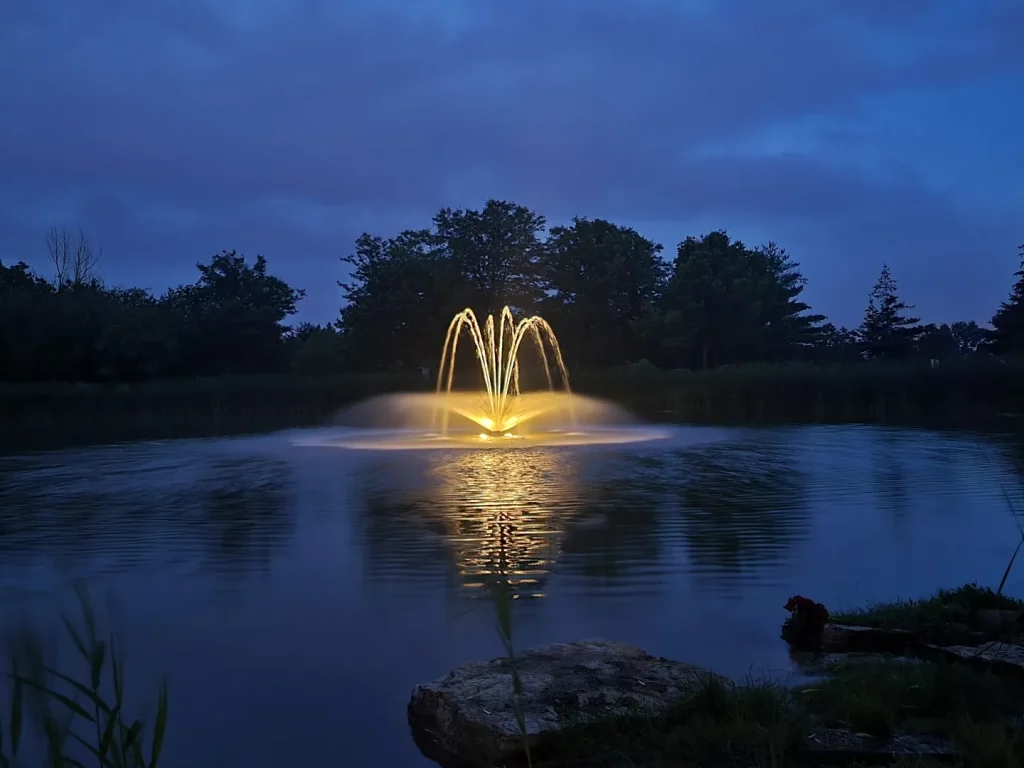
Options include spray patterns, LED lights, controls and anchoring that suits the pond. LED lights use far less power than older halogen lights and turn the pond into a night-time feature.
How we choose the right system.
01
Look at the pond
We note size, depth, shape, inflows, sun exposure and how people use the site.
02
Name the problem
Algae, odour, muck and mosquitoes point to aeration. A healthy pond that needs presence points to a display.
03
Check power and access
Distance to power matters for cable runs and safety controls. Long runs need careful installation to avoid leakage trips.
04
Match the equipment
We carry products from most major North American floating fountain makers, including Kasco Marine, Aqua Control and Aqua Master.
05
Plan the seasons
Floating fountains come out each fall for service. De-icers or circulators can protect docks and boathouses over winter.
Can one unit do both?
To a degree, yes. Every floating fountain adds some oxygen, and some models are built to balance display and aeration.
For larger or deeper ponds, a common approach pairs a fountain for the look with surface or diffused aeration for the water. Stormwater ponds often need pond and lake aeration first, with a display added where people see it.
Where algae is already established, aeration works best alongside a water treatment program. Our algae control and water treatment service covers testing and treatment.
Keeping either one running.
Both need regular service. Motors need fresh oil, new seals and testing, and cables need checking for leakage.
One floating fountain we were called to had been out of service for a long time. Several electricians and motor shops had failed to fix it. We took amperage readings and measured leakage on the long cable run with a milliamp reader, since anything over 5 milliamps trips the panel’s safety controls.
The cause was a small leak in the quick disconnect, which we repaired. Our sister company Fountain Depot runs an authorized Kasco repair centre with a 17-step motor service and a final wet and high-potential test.
Our sister company
Parts, pumps and fountains ship from Fountain Depot.
Compare floating fountains, surface aerators and diffused aeration systems at Fountain Depot, our sister company’s online store.
Fountain and aerator questions.
Does a floating fountain stop algae?
It helps by adding oxygen and circulation, which makes conditions harder for algae. Ponds with heavy nutrient inflow usually also need dedicated aeration and water treatment.
Can a floating fountain have lights?
Yes. LED light kits mount on the float and light the spray at night, using far less power than halogen lights.
Should a floating fountain stay in over winter?
In most Ontario ponds, no. We remove it in fall, service it and reinstall it in spring. Where open water is needed, a de-icer or circulator does that job.
Do you service fountains bought elsewhere?
Yes. We fully service Kasco Marine, Aqua Master and Aqua Control units, and test and maintain Otterbine, Airolator, AirMax, OASE and Arbrux units.